Tradeline's industry reports are a must-read resource for those involved in facilities planning and management. Reports include management case studies, current and in-depth project profiles, and editorials on the latest facilities management issues.
Latest Reports
Flexible Containment Suites that can be Reconfigured by Biosafety Level and Lab Size
The strategic use of specialized doors and biocontainment cubicles in Weill Cornell Medical College’s new academic research facility maximizes flexibility by allowing the floor plan to be easily reconfigured for different levels of containment and program size.
Introducing Space Optimization and Sustainability at Historic King’s College
London’s King’s College has tapped building information systems and financial data to maximize the use of space while reducing energy costs and carbon emissions by employing three strategies: leveraging shareable and flexible space, challenging assumptions about the need for individual offices, and having leaders set progressive examples for other staff. Efficiently planned and utilized spaces are inextricably linked with sustainability for growing academic institutions like King’s College, especially when the cost of property is expensive, according to architect and planner Ian Caldwell.
UMass Amherst Employs Core and Shell Strategy for Life Science Laboratories
Using a phased, core-and-shell strategy to construct the 310,000-gsf Life Science Laboratories (LSL) building allowed the University of Massachusetts Amherst to obtain high-level research space and take advantage of the competitive bid market and economic incentives available in 2010. The approach also provided economies of scale and the advantage of postponing programming and occupancy decisions with subsequent fit-outs.
Neuroscience Research Building
In response to evolving needs and changing research emphases, a major addition to the Institute for Human Performance (IHP) at the State University of New York (SUNY) Upstate Medical University expands the research focus beyond human activity and rehabilitation to encompass exploration of disorders of the nervous system, including behavioral disorders, such as ADHD; diseases of the eye; and neurodegenerative diseases, such as ALS, Alzheimer’s, and Parkinson’s.
First-Year Biology Teaching Labs
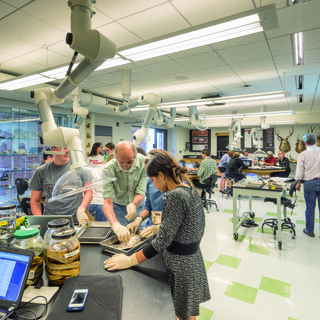
The University of Toronto, Mississauga, re-imagined its first-year biology teaching labs to update the space and encourage a more experiential learning environment that will hook students on biology and engage the entire building in what goes on there. They also need to accommodate classes of as many as 48 students, which their former space could not.